
Your eyes say a lot – sometimes more than you’d like. Heavy, drooping lids can make you look exhausted when you’re not. Puffy bags under your eyes can age you by a decade. When people notice these changes, they often wonder whether eyelid surgery might help — but quickly realize there is more than one kind.
Upper and lower eyelid surgery address completely different problems, involve different techniques, and deliver different results. Knowing which one is right for you – or whether you may need both – starts with understanding what each procedure actually does.
What Is Upper Eyelid Surgery?
Upper eyelid surgery, known medically as upper blepharoplasty, focuses on the skin and tissue above your eye. Over time, the skin of the upper eyelid stretches, loses elasticity, and begins to sag. In some cases, it can droop so low that it actually impairs your vision.
During the procedure, a surgeon carefully removes excess skin and, sometimes, a small amount of fat or muscle through an incision placed naturally within the eyelid crease. Because the incision follows the natural fold, the resulting scar is virtually invisible once healed.
Upper eyelid surgery is typically the right conversation to have when you’re experiencing:
- A heavy, hooded feeling over your eyes
- Difficulty applying eye makeup because the lid fold is obscured
- Eyebrows that seem perpetually raised – your body’s way of compensating for drooping lids
- Peripheral vision that feels narrowed or blocked
- A look of constant tiredness, even after a full night’s sleep
Recovery is generally straightforward. Most people return to light activity within a week, with swelling and bruising settling down over two to three weeks. The results – a more open, alert, refreshed appearance – are long-lasting, often a decade or more.
What Is Lower Eyelid Surgery?
Lower eyelid surgery (lower blepharoplasty) targets a completely different zone: the area beneath your eye. The concerns here tend to be puffiness, hollowness, dark circles rooted in shadowing, and loose or crepey skin just below the lash line. These changes are driven largely by fat repositioning – the natural fat pads around the eye shift or protrude with age – and by a gradual loss of skin firmness.
The surgical approach for the lower lid is more nuanced than the upper, and the technique varies depending on what’s causing the problem.
- Transconjunctival approach: The incision is made inside the lower eyelid, leaving no external scar. This works especially well when the primary issue is excess or displaced fat with relatively good skin tone.
- Subciliary approach: A small external incision is made just below the lower lash line. This allows the surgeon to address both fat and excess skin. The scar sits so close to the lashes that it becomes nearly imperceptible.
Lower eyelid surgery can also involve fat repositioning rather than removal – moving fat from a bulging area down into the hollow (called the tear trough) to smooth the transition between the lower lid and the cheek. This is a more sophisticated technique that creates a very natural-looking result, rather than simply deflating the area.
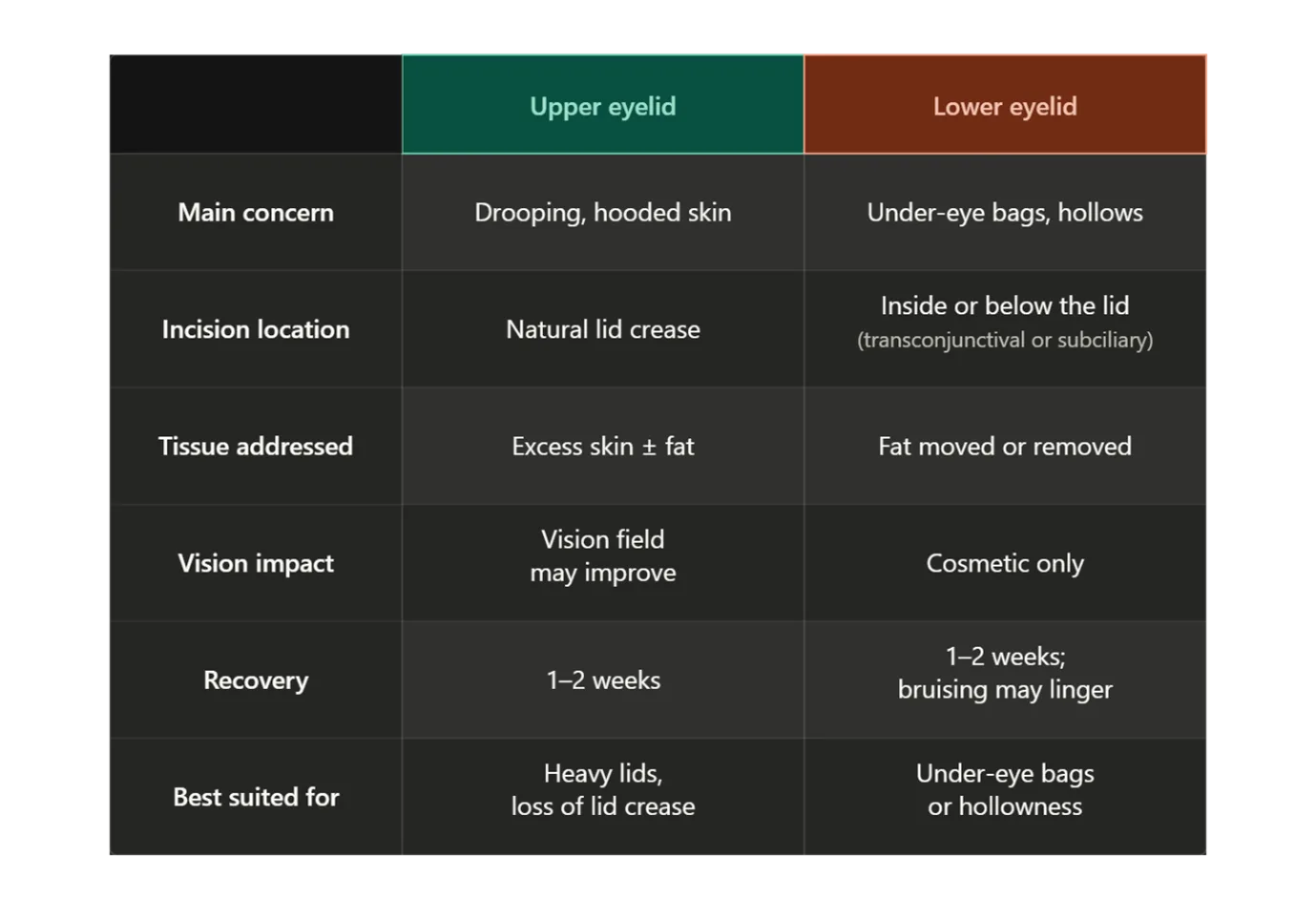
Upper vs. Lower: The Key Differences at a Glance
Can You Have Both Done at the Same Time?
Yes, and it’s quite common. The eyes function as a unit, and addressing one area while leaving the other unchanged can sometimes create an imbalance. Many patients who come in focused on one concern discover that combining the procedures yields the most harmonious result.
Having upper and lower blepharoplasty together doesn’t necessarily mean double the recovery time. Since you’re already healing, combining the procedures means one anesthesia event, one recovery period, and typically a more cohesive transformation. Your surgeon will assess your anatomy and goals and advise on what makes sense for you.
What About Ptosis – Is That the Same Thing?
Not exactly. Ptosis (pronounced “TOE-sis”) is a specific condition where the drooping is caused not by excess skin, but by a weakened or stretched muscle inside the eyelid – the levator muscle – that is responsible for lifting the lid. It can affect one or both eyes and may be present from birth or develop with age.
Ptosis repair is a distinct surgery from blepharoplasty, though the two can look similar from the outside and are sometimes performed together. If your upper lid droops but the skin itself doesn’t seem excessive, ptosis may be the underlying cause. A thorough evaluation will tease out the difference.
How to Know Which Procedure You Need
The honest answer: a proper in-person evaluation is the only way to know for certain. Photos help, but eyelid anatomy is nuanced. Factors like your skin quality, the amount and position of orbital fat, your brow position, and any underlying muscle function all play into which approach will serve you best.
A few guiding questions worth reflecting on before your consultation:
- Is the puffiness above or below your eyes?
- Do you look tired even when you feel rested?
- Has anyone suggested you look angry or sad when you’re not?
- Do you notice a loss of your eyelid crease when you look in the mirror?
- Are you bothered by bags, hollows, or dark shadowing under your eyes?
Bringing these observations to your consultation gives your surgeon a clearer picture of your goals and helps set realistic expectations for what surgery can and can’t address.
The Bottom Line
Upper and lower eyelid surgery each solves a specific problem. Upper blepharoplasty lifts and opens; lower blepharoplasty smooths and refreshes. They’re not interchangeable, but they’re also not mutually exclusive. What matters most is a careful assessment of your individual anatomy and an honest conversation about what you want to achieve.
At Mehta Facial Plastics, eyelid surgery is one of our most sought-after procedures – and for good reason. The results are natural, the recovery is manageable, and the change in how patients feel about their appearance (and how rested they look to the world) is genuinely meaningful. If you’re ready to explore your options, schedule a consultation, and let’s talk about what’s possible for you.